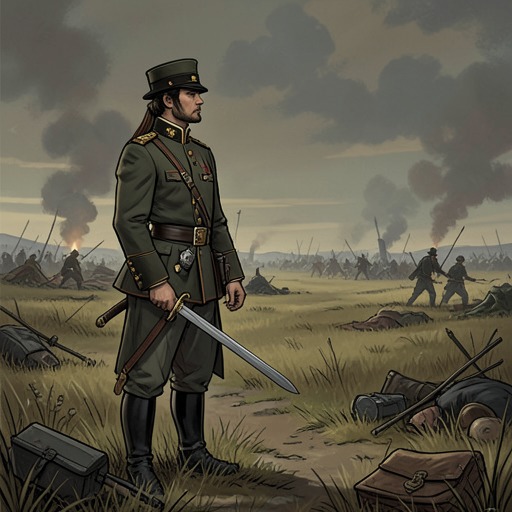
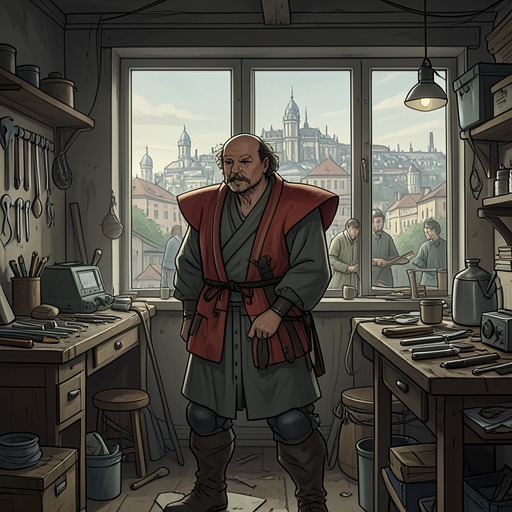
The Twofold Way of Pen and Sword
The Book of Five RingsThe Twofold Way of Pen and Sword names a paired ideal: the warrior should cultivate both learning and martial practice. In the Ground Book, this ideal is not a decorative balance between two accomplishments but part of a larger account of strategy as a Way that must be studied broadly, absorbed into the body, and proved in action.
Meaning and Scope
The book places the warrior’s discipline among many possible Ways: religious salvation, Confucian learning, medicine, poetry, tea, archery, and other arts each have their own practitioners. The warrior’s distinctive path joins pen and sword, and the text says that even someone without natural ability can become a warrior by persevering in both divisions. It also distinguishes this discipline from mere readiness to die: strategy is directed toward overcoming opponents, whether in a crossing of swords with one person or in battle against large numbers, and victory can bring power and fame to the practitioner or their lord.
The pairing does not mean that every art becomes part of the warrior’s Way. The text explicitly excludes Confucianism, Buddhism, certain traditions, artistic accomplishments, and dancing from that Way. Yet it also argues that broad knowledge allows a student to recognize the Way in everything, while each person must polish their particular discipline. The twofold ideal therefore combines a focused craft with a wide capacity to learn from other domains.
Strategy as a General Discipline
The book makes the sword a model for strategy at every scale. Masters of the long sword are called strategists, while practitioners of the bow, spear, gun, and halberd receive names tied to their particular weapons. These weapons all belong to military practice, but mastery of the long sword is presented as the basis for governing both the world and oneself. The text extends the arithmetic of individual skill outward: one person may overcome ten, a hundred may overcome a thousand, and a thousand may overcome ten thousand. Principles first stated through single combat must therefore be understood in relation to battles involving ten thousand on each side.
This widening scope gives the Twofold Way practical and intellectual force. Strategy is not simply the possession of a weapon or a collection of techniques; it is a craft whose principles can guide conduct across different scales. The book warns that even a slight misunderstanding of the Way can bewilder a student and lead them astray, making accurate understanding more than a matter of terminology.
From Reading to Embodied Knowledge
The book rejects reading as a sufficient route to strategic understanding. A student must not merely read, memorize, or imitate its instructions, but absorb them inwardly until the principles are realized and embodied. Its oral teaching compresses that demand into the instruction to teach the body strategy. Written explanation supplies material for study, but the student must turn it into practiced capacity.
The prescribed training begins with concrete bodily disciplines. The stance calls for an erect head, composed features, a straight neck, lowered shoulders, strength through the legs, and a braced abdomen; the companion sword is wedged against the abdomen so the belt does not slacken. The same combat stance should be maintained in everyday life, and everyday posture should become combat posture. The gaze likewise joins close and distant attention: the student should see distant things as if close and close things from a distance, distinguish the enemy’s sword from insignificant movements, and learn to attend to both sides without shifting the eyes.
Weapon handling and footwork make the same principle tangible. The long sword is held with a controlled distribution of pressure across the fingers, with neither slack nor rigidity; a living hand remains pliable rather than fixed. The feet should move as in ordinary walking, with the heels firm and the toes somewhat floating, while Yin-Yang footwork prevents reliance on one foot alone. These instructions connect perception and action: a strategist learns not only what to notice but how trained posture, grip, and movement make response possible.
Timing, Contact, and Practice
Strategic knowledge culminates in action at the right instant. In the method called “In One Timing,” the fighter closes and strikes directly while the opponent remains undecided—before the opponent chooses to withdraw, break, or attack. The book insists that this timing must be trained until the fighter can act in an instant. Knowledge of a principle is thus incomplete until practice has made its application prompt.
Other instructions show how this practical knowledge depends on the whole body rather than on arm technique alone. In “Glue and Lacquer Emulsion Body,” the fighter approaches and remains attached to the opponent, joining head, body, and legs without leaving a gap; the text cautions that people often advance the head and legs while letting the body lag. In the Body Strike, the fighter enters through an opening in the guard, turns the face slightly aside, and thrusts the left shoulder into the opponent’s breast in time with the breath. The prescribed impact can knock an opponent ten or twenty feet away and, the text says, may continue until the opponent is dead. These methods make the body both the instrument and the site of strategic learning.
The learning process is gradual and cumulative. Students are told to begin with the five approaches and five attitudes, absorb the long-sword Way naturally, and bring spirit, timing, sword handling, body, and legs into harmony. They should take the book one item at a time, learn through fighting opponents, and patiently absorb its principles, raising a hand in combat from time to time. The thousand-mile road is walked step by step: study continues over years, and victory over oneself today becomes the basis for overcoming more capable opponents later. Even killing an enemy does not count as following the true Way if the action is not grounded in what has been learned.
The Way and the Void
The book ultimately places this training within a disciplined understanding of the Void. What a person does not understand is not thereby the Void; in strategy, treating incomprehension as attainment is only bewilderment. The student must study martial arts fully without deviating from the warrior’s Way, and practice steadily, day by day and hour by hour. Settled spirit, a mind and heart polished together, and a gaze sharpened in perception and sight are presented as conditions for bewilderment to clear.
In this final account, the Twofold Way is neither a simple pairing of book learning with combat nor permission to treat every pursuit as equivalent. It calls for commitment to a particular craft, broad understanding, and repeated embodied practice. The pen can set out principles, but only sustained training makes them available as perception and action; the sword, in turn, becomes a measure of whether those principles have truly been absorbed.